The Cost of Being Palatable
We’ve all been there. A meeting at work where you have a good idea or much-needed opinion to contribute, but it might rock the boat too much to bring it up. A previous relationship that was easier to manage when you softened your boundaries or went with the flow. That time at a party where it was easier to just nod, fake laugh, and smile through the discomfort rather than speak up. “Rocking the boat” may be an adage, but one still applicable today existing to remind women that speaking up and standing out are not suggestable activities. Why rock the boat, when you can sit down, shut up, and allow the calm, unprovoked seas to drift us away?
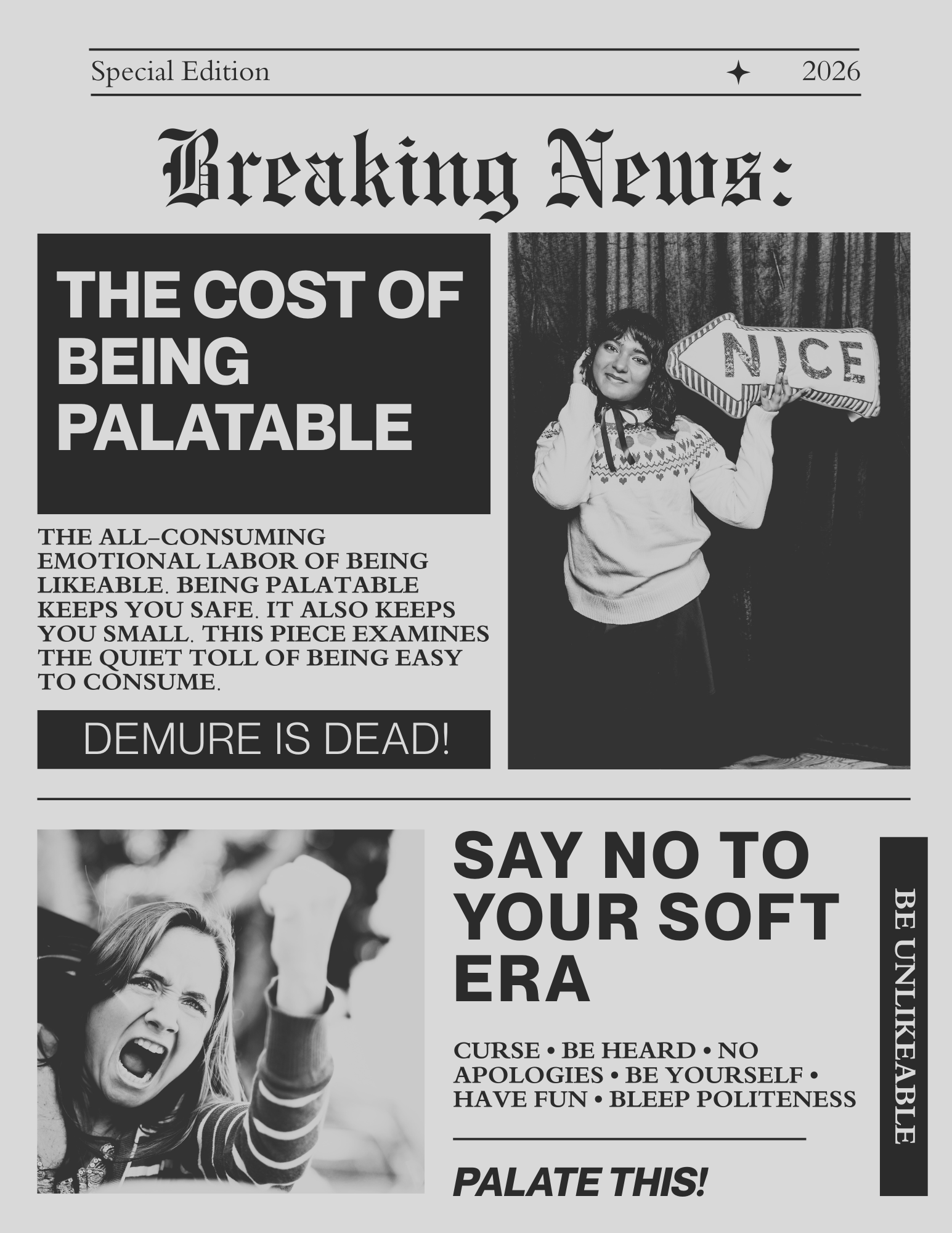
When it comes to society’s palate, you can argue left, right and center but the truth remains the same: quiet, easy-going women are tastier, easier to consume, and digest faster. Women are rewarded for being easy to consume and punished for being hard to ignore. So, while being palatable can help keep you safe, it also keeps you small. There is an often unsung and quiet toll of being easy to consume, and the dangers behind this self-preservation technique are pervasive and real.
David Fincher’s “Amy Dunn” may have phrased it best herself: “Cool girl. Men always use that, don’t they? As their defining compliment: ‘She’s a cool girl.’ Cool girl is hot. Cool girl is game. Cool girl is fun. Cool girl never gets angry at her man. She only smiles in a chagrined, loving manner. And then presents her mouth for fucking.” These “compliments” exist all around us, serving as a verbal reminder of what is expected of us: “low maintenance.” “Agreeable.” “Chill.” “Down-to-earth.” “Nice.” “Easy to work with.” All derivatives of what is ultimate deemed “Palatable.” These labels, while praised socially and hung up on the mantle as terms of endearment, often come at the cost of honesty, growth, ambition, and success. Don’t get it twisted, ladies: “palatable” is just another word for non-threatening.
In fact, showing the same attributes that your male counterparts do within the workplace, can negatively impact professional growth and career success. In a Columbia Business School study, women who displayed the same assertive leadership traits as men, are liked less and seen as less hirable (Heilman, M. & Okimoto, T. (2007)). How are you going to rise up the corporate ladder, bring in more cash, and curate a life of ultimate success? Certainly not by inserting your valuable voice, ideas, input, and setting personal and professional boundaries; all that seems to accomplish is to make one unappealing, and thus un-hirable.
Being “nice” but also want to offer your expertise? It seems it is also unappealing to be heard in the workforce, with women being interrupted significantly more in meetings, especially by men, reinforcing that same pressure to be agreeable, rather than to be heard (Karpowitz & Mendelberg (2014); West & Zimmerman (1983)).
The Amy Dunn “Cool Girl” factor can affect not only your professional life, but apparently your social life as well. Research shows women who negotiate or self-advocate, are more likely to face social backlash, compared to men (Bowles, H. R., Babcock, L., & Lai, L. (2007)). When the cost of standing up for yourself is upsetting friends, family, and your possible social network, then the “easier” option seems to be sitting down and shutting up.
These are the areas where women get penalized (among many), a place I like to call “The Likeability Trap.” Everyone wants to be liked, adored even, it’s simple biological human nature. Social death penalties like human shunning are a prime example of this human need to be social, to the point that when humans get excluded the brain catalogues this as actual physical pain, lasting longer and deeper than an actual bodily injury (Kross, E. (2024). How religious shunning ruins lives. Psychology Today). And society teaches females in particular that we should be likeable, agreeable, and adored. So, this Likeability Trap factors into a majority of female decision making, trapping them in the double bind of what works for men, versus what works for them. A loud, assertive man is seen as a confident leader, while assertive women (and minorities particularly) are seen as “difficult,” “angry,” “abrasive,” and ultimately, unlikeable.
While in the moment (and to climb that corporate ladder plus keep your friends) it may be easier to fall into the Likeability Trap, the long-term cost is severe. Agreeability and being palatable may provide short term harmony and avoid rocking that proverbial boat or ruffling any feathers (the limit to sit-down-and-shut-up sayings does not exist) but comes at the price of long-term self-abandonment. The unique perspective your experience and expertise provide, the energy you light up a room with, the voice that you spent your entire life curating, all muted and silenced. All those years of school you worked so hard for? What good are they when you are silent, likeable, agreeable, and palatable?
What was once a work of pure fiction now serves as a chilling warning to any woman striving to remain palatable today: The Handmaid’s Tale. In Margaret Atwood’s television retelling, we watch the character Ofglen have her tongue cut out after speaking out against an injustice. A dramatic, dystopian punishment, yes, but one that echoes a much quieter truth we still live with: women are often disciplined (socially or professionally), for refusing to stay agreeable.
The long-term costs of being palatable are less cinematic but far more common: burnout, resentment, self-erasure, career stagnation, imbalanced relationships, and the slow erosion of self-trust. You don’t lose your voice overnight, you lose it one softened opinion, one swallowed boundary, one strategic silence at a time. And eventually, the performance becomes so practiced that it’s hard to remember which parts of you were edited for comfort and which parts were real.
Unlearning palatability isn’t about becoming cruel or careless. It’s about noticing where you’ve been shrinking to survive, and deciding, deliberately, to take up space again.
Let’s be real: being palatable is an actual survival mechanism. This is a strategy to protect, and thus an important tool that you’ve potentially used and needed. This is a learned behavior, provided by all kinds of societal, environmental, and psychological factors, that often does provide safety and protection in certain circumstances. Palatability is not a choice women make in a vacuum, sometimes it’s the safest option in rooms that aren’t built for you. The cost does build up over time however, compounding even when you don’t see, hear, think or notice. But safety built on self-editing has an expiration date.
We don’t owe the world our softness at the expense of our existence. We’re allowed to take up space, to speak in full sentences, to want without shrinking. We’re allowed to be seen in our entirety. If the cost of being easy to consume is losing oneself, then we should all be learning how to be more difficult to swallow.